17 HOA Amenities that Every Association Must Have

Homeowners care about the basics first. Well-chosen HOA amenities make daily life easier, safer, and more pleasant. This guide ranks the essentials from highest to lower priority so boards can invest where it matters most.


Top-Priority HOA Amenities Residents Expect

Residents lean on these features every single day. Start here before adding anything fancy, because these choices shape how safe, connected, and comfortable the community feels. When the fundamentals are in place, everything else becomes easier to manage.


1. Reliable Connectivity in Shared Spaces

homeowners association amenities

Strong Wi-Fi and steady cell coverage in lounges, pool areas, and meeting rooms should be a given. People work, stream, and call family from community spots, so a reliable signal matters. This is one of the HOA amenities that delivers value to every resident, every day.

The payoff is smoother remote work, easier telehealth and e-learning, and more effective use of common areas. Strong connectivity also supports smart building tools and simple room reservations, reduces complaints to management, and signals a modern, well-run community to buyers and renters.


2. Safety Lighting, Access Control, and Cameras

Good lighting, controlled entry, and sensible camera coverage help people feel safe. Focus on gates, lobbies, garages, paths, and mailrooms. Clear signage about recording sets expectations and supports privacy.

Stronger safety coverage deters nuisance activity, shortens incident resolution time, and makes evening walks feel comfortable. Residents use amenities more often when they feel secure, deliveries go more smoothly, and a visible safety posture can support insurance negotiations and resale confidence.


3. Parking That Works for Daily Life
hoa common areas

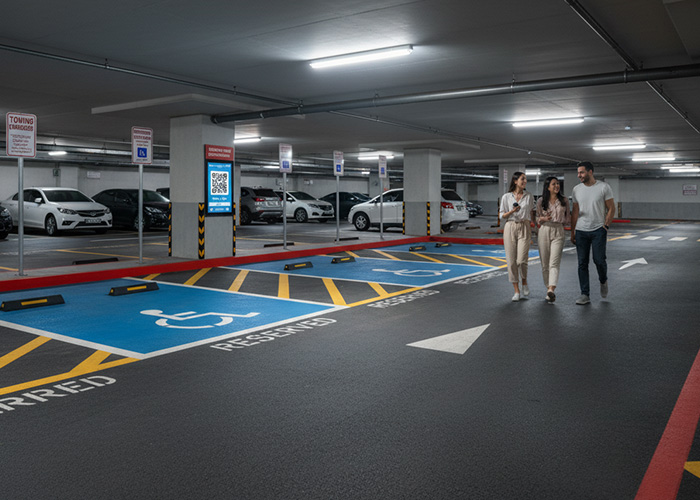
Parking friction can sour community life. Residents want assigned spaces that feel fair and a simple guest process. Signs and striping should be obvious, even at night.

When parking is predictable, neighbors argue less. It also helps ensure guest visits run smoothly and accessible spaces remain open for those who need them. Having clear systems protects curb appeal, keeps fire lanes unobstructed, and helps emergency responders get where they need to go.


4. Clean, Accessible Restrooms Near Activity Hubs

Events run more smoothly when restrooms are clean, closed, and safe. Touchless fixtures, slip-resistant floors, and grab bars would be a big help for everyone. Additionally, having a diaper station and clear cleaning logs demonstrates that your association is committed to care.

Easily accessible, inclusive restrooms keep events running smoothly and make families and older adults feel valued. Cleaner facilities mean fewer service calls and a stronger first impression for visitors.


5. Pool and Spa Built for a Warm Climate
homeowners association amenities

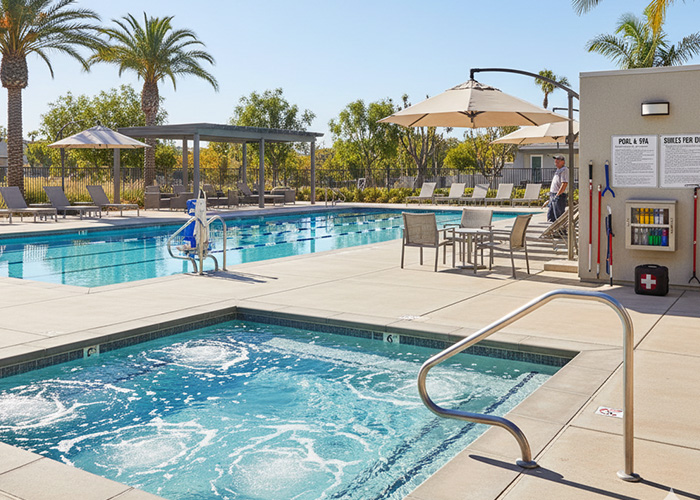
In Southern California, a pool is a core draw. Shade, seating, and safe surfaces matter as much as water clarity. Post hours and simple rules so families and lap swimmers can share the deck in peace.

With shade, seating, and safe surfaces, the pool becomes a social anchor rather than a hot slab. Different users share the deck more easily. Additionally, the amenity is well-represented in photos and tours.


6. Secure Mailroom and Package Lockers

Online shopping will not slow down. Lockers or secure shelving reduce lost parcels and cluttered corners. Bright lighting and a camera near parcel zones deter tampering.

A secure, well-lit pickup point turns delivery season into a quick errand. You’ll have fewer missing parcels and less clutter in the lobby. These all translate into calmer residents and fewer headaches for staff.


7. Shaded Play and Picnic Nooks
hoa common areas

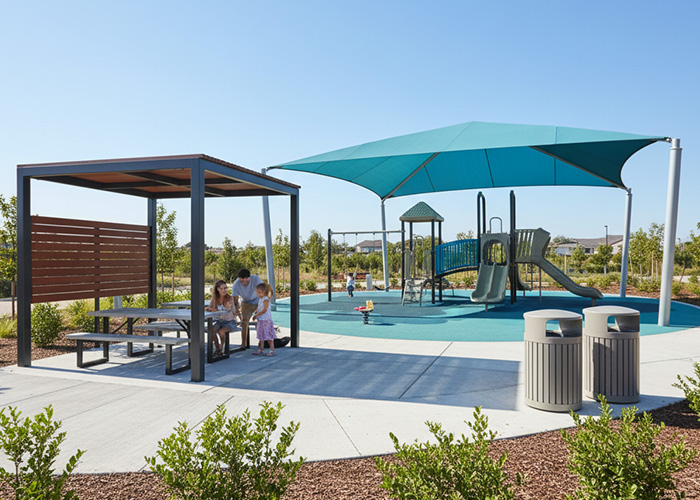
Families look for safe play with nearby seating. Shade sails, age-appropriate equipment, and cooler surfaces keep the area comfortable. A few picnic tables turn a quick stop into a relaxed afternoon.

Shade and clear sightlines invite longer stays and honest conversation. Kids explore within view while caregivers relax, and the daily rhythm of the place feels friendlier.


8. High-Impact Upgrades That Pay Off

Once the daily must-haves are in place, select upgrades that reach the most residents and manage long-term costs effectively. These additions build convenience, health, and resilience. They also create clear talking points when boards explain budgets and reserves.


9. Flexible Clubhouse or Multipurpose Room
homeowners association amenities

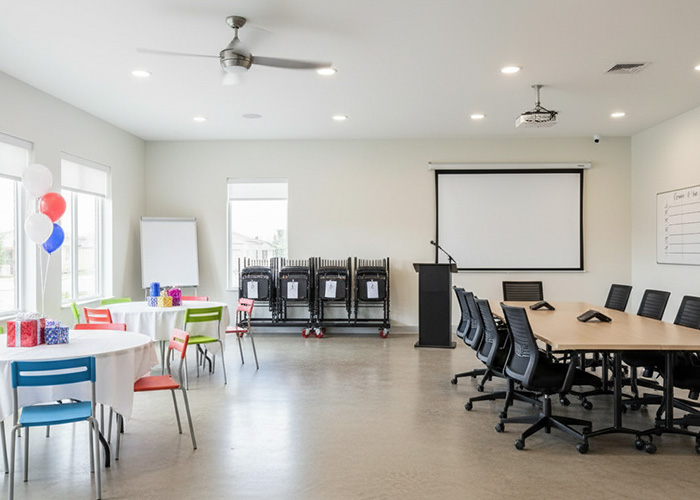
Residents love a room that shifts from birthday party to board meeting. Good airflow, durable floors, and simple storage make turnover easy. Additionally, having a basic AV setup covers movie nights and presentations.

The clubhouse or rooms can cater to events on the calendar instead of sending people off-site. By renting these out for a small fee, it can still add up and help support reserves. The space even doubles as a dependable gathering point during times of disruption.


10. Fitness Room and an Outdoor Walking Loop

Many people prefer a quick workout close to home. A modest room with bikes, treadmills, and mats, paired with a marked outdoor loop, supports daily movement. Benches and natural shade along paths invite repeat visits.

When movement lives a short walk away, people actually use it. A simple gym and a welcoming loop fold exercise into daily routines.


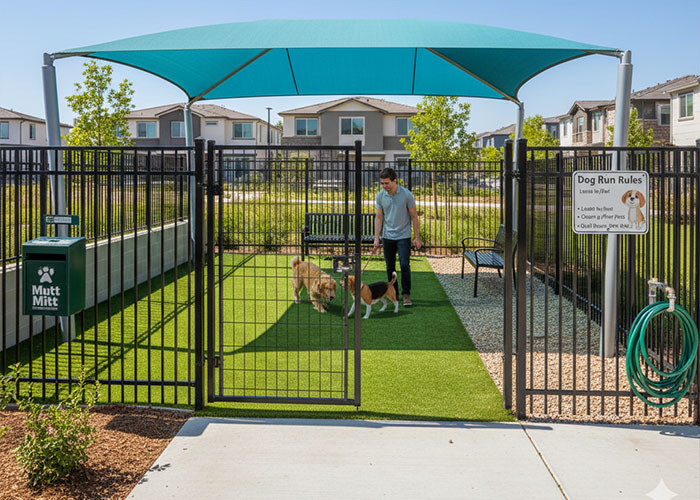
11. Pet-Friendly Spaces and a Small Dog Run
hoa common areas

Pet owners value places where they can walk and gather. A compact dog run with double gates, turf or gravel, shade, and a few benches does the job. Bag stations and trash bins keep the area clean, making them great additions to these HOA amenities.

Dedicated pet zones channel energy where it belongs and keep lawns looking crisp. Owners meet, the grounds stay cleaner, and the community reads as pet-savvy rather than pet-tolerant.


12. EV Charging and Electrical Readiness

More residents drive electric vehicles each year. A few shared chargers near main entries meet current demand and prepare the community for growth. Conduit runs in key spots to lower future costs.

Having an EV charging amenity today signals that your association has foresight. Fair access and clear pricing keep use orderly today while the infrastructure scales as more households plug in.


13. Water-wise Landscaping and Community Gardens

homeowners association amenities

Drought-aware design saves water and still looks great. Drip irrigation, mulch, and native plants reduce maintenance. A few raised beds give residents a place to grow herbs and greens.

Landscapes that suit the climate remain visually appealing with less water. Native beds retain their shape through heat, attract pollinators, and provide residents with small spaces to grow something fresh.


14. Sports Courts People Actually Use

Pickleball is popular, and multi-use striping lets one court handle several games. Sound-dampening screens and reasonable hours help with noise concerns. Nearby seating encourages short matches and quick turnover.

A court that stays in motion becomes a casual meeting point. Multi-use lines invite short games and steady activity. They promote fitness and friendly competition without a big programming budget.


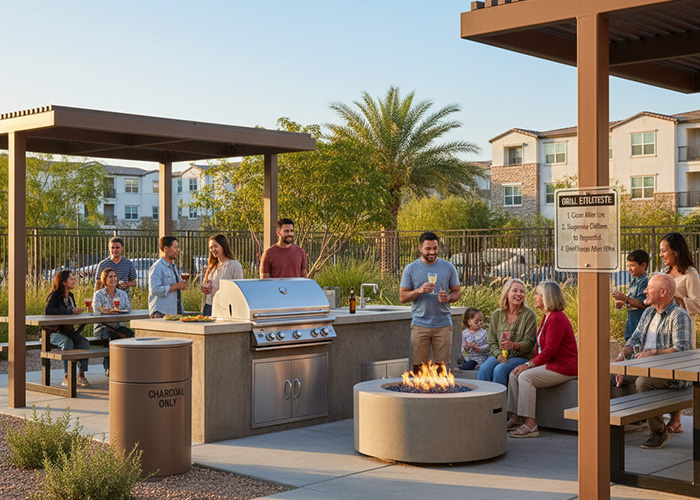
15. BBQs and Fire Pits
hoa common areas

Food brings neighbors together. Grills with sturdy prep space and posted cleaning steps see steady use. Where permitted, gas fire pits extend evening hours.

Cooking together lowers the barrier to conversation. Evenings feel longer, and small celebrations become easy to host without leaving home.


16. Waste Management and Recycling Areas

Clean collection areas protect health and deter pests. Lids that close, clear signs, and frequent pickup matter. A rinse spigot helps after spills.

When sorting is obvious and lids close, cleanliness almost takes care of itself. Fewer pests, better smells, and steadier hauling costs are the quiet payoff.


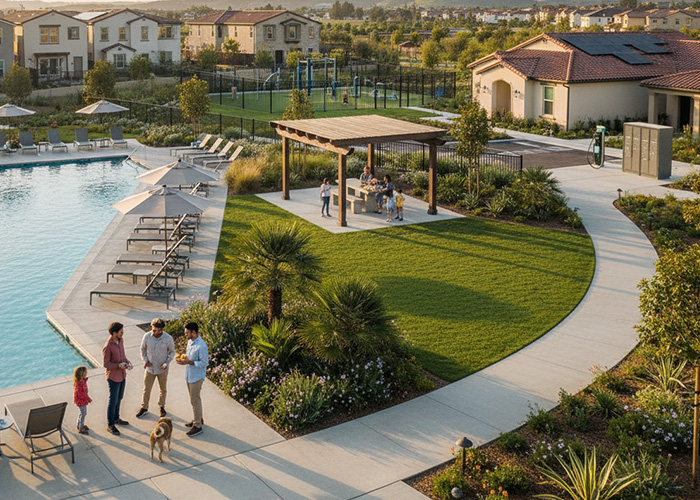
17. Event Lawn and Pocket Parks

homeowners association amenities

A flat, flexible lawn hosts movie nights, markets, and fitness classes. Small shade trees and string lights encourage lingering. Edges with benches invite casual use.

Having a simple lawn earns its keep as the backdrop for yoga, markets, and movie nights. It enhances the neighborhood’s appeal, providing property listings with an image that potential residents recognize as part of everyday life.


Budget, Rules, and Good Communication

Great homeowners association amenities do not surprise anyone. Share the plan early and explain how each project supports safety, comfort, or savings. Tie changes to maintenance cycles so dollars stretch farther.

Keep rules short and consistent across spaces. Post them where they are helpful, not where they are annoying. When residents know what to expect, they take better care of shared places.


Community Use

Homeowners choose communities that make ordinary days smoother. Start with safety, cleanliness, and access, then add the extras that bring people together. With a clear plan and steady care, your HOA amenities will feel thoughtful, helpful, and worth the budget.

Need professional help in choosing your community’s amenities? Personalized Property Management offers HOA management services around Southern California. Call us at 760-325-9500 or email us at info@ppminternet.com for more information!


Related Articles:


California HOA Foreclosures: Can The HOA Really Take Your Home?

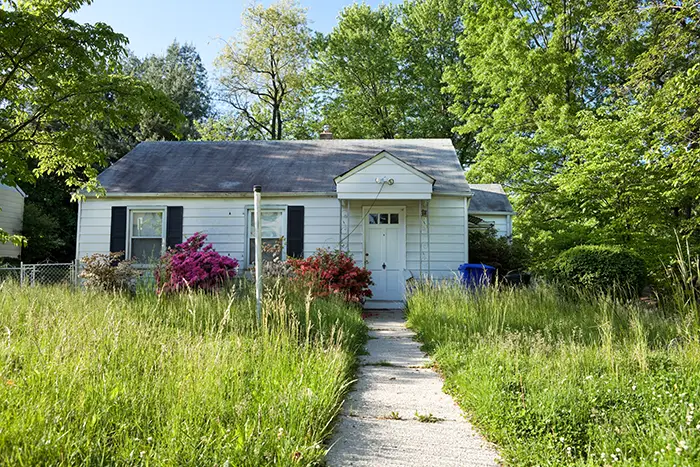
No homeowner ever imagines losing their house because of unpaid HOA fees. However, rules about California HOA foreclosures can be quite confusing, leaving many homeowners and even some board members asking: Can the HOA really take your home?

Why Would a California HOA Foreclose on a Home?

In short, money. Like any other organisation, an HOA relies on funding to function. Dues and assessments help pay for things the community depends on, such as landscaping, repairs, amenities, insurance, and reserves for future needs.

When too many homeowners fall behind on payments, it puts pressure on the association’s budget. If polite reminders and late notices don’t work, the HOA may need to escalate the collection process, and foreclosure is often the last stop on that road.

The Legal Foundation: How Can an HOA Foreclose in California?

The right to foreclose doesn’t just come out of thin air. It’s part of state law.

Under the Davis-Stirling Act, HOAs can place HOA liens in California on properties when owners fall behind on assessments. A lien gives the HOA a legal claim against the property, similar to how a bank’s mortgage works.

Once that lien is in place, the HOA can, if necessary, pursue foreclosure through nonjudicial means (meaning, outside of court) to recover the debt.

Of course, there are guardrails to protect homeowners, which we’ll cover shortly. But make no mistake: HOA foreclosure in California is absolutely legal under state statute.

The Debt Threshold: When Does Foreclosure Become an Option?

California doesn’t allow HOAs to jump straight to foreclosure over minor debts. Here’s what the law requires:

  • The homeowner must owe at least $1,800 or have been delinquent for at least 12 months, whichever comes first.
  • The HOA must have first attempted other collection efforts, including notices, payment plans, and more.

Only after those conditions are met can the HOA record a lien and begin the foreclosure process. In practice, most boards use foreclosure as a tool of last resort—because it’s expensive, time-consuming, and can inflame community tensions.

But when all else fails, the law allows it.

How Long Does It Take for an HOA to Foreclose?

How long does it take for an HOA to foreclose in California? Well, it varies.

First, there’s a mandatory 30-day pre-lien notice. After the lien is recorded, there’s another 90-day waiting period before foreclosure proceedings can even be scheduled.

From there, it often takes several more months for legal notices, trustee’s sale scheduling, and the actual foreclosure sale.

So even in a worst-case scenario, you’re looking at a process that typically spans 6–12 months (sometimes longer). Homeowners aren’t losing their homes overnight, but once the wheels are in motion, stopping them becomes harder the longer the debt lingers.

Can an HOA Take Your Home for Unpaid Fines?

It depends. Under California law, HOAs cannot foreclose on fines alone, not for things like parking violations or minor rule breaches.

However, if those fines become part of an unpaid assessment balance (for example, due to legal fees or enforcement costs), the situation can become murky.

Boards need to be cautious, and homeowners should consult with an attorney if fines are suddenly showing up on a foreclosure notice.

What About Special Assessments?

old house | california hoa foreclosures

Special assessments, unlike fines, are considered assessments just like regular dues. That means they can trigger a lien and potentially initiate foreclosure if the amount remains unpaid.

So when a board approves a major repair project or capital improvement, homeowners need to budget for those assessments, because ignoring them can put their home at risk.

Who Buys the Home at HOA Foreclosure Sales?

You might picture the HOA board members themselves “taking” someone’s home. But that’s not really how it works.

HOA foreclosures in California are handled through a nonjudicial trustee’s sale (basically, an auction). Typically:

  • Investors buy the home at auction, sometimes for pennies on the dollar.
  • The HOA recovers what it’s owed from the sale proceeds.
  • The former homeowner loses their property, but any remaining mortgage debt still sticks with them.

In some cases, if no one bids at auction, the HOA itself may take title temporarily. But most boards are eager to avoid that outcome.

Can an HOA Foreclose on a Home with a Mortgage?

Can an HOA foreclose on a home even if there’s a mortgage in place? Yes, though it gets tricky.

Here’s the wrinkle: a first mortgage generally takes priority over an HOA lien. So if the HOA forecloses, the mortgage lender doesn’t just disappear. The new buyer at auction either takes on the mortgage or risks a bank foreclosure down the line.

Because of this risk, auctions for California HOA foreclosures tend to attract sophisticated investors, not casual buyers. In some cases, lenders may step in and pay off the HOA debt to avoid losing their position.

What Happens to the Homeowner After Foreclosure?

Sadly, the outcome for the homeowner can be devastating. They lose their property, often for much less than it’s worth. Sometimes, they may still owe the mortgage lender. Their credit takes a massive hit, and recovering financially can take years.

That’s why California HOA foreclosures are something both boards and owners should avoid if at all possible.

Payment Plans: A Lifeline for Homeowners

Thankfully, California law requires HOAs to offer payment plans before initiating foreclosure. These plans:

  • Must be provided in writing
  • Can span at least 12 months (though boards can offer longer terms)
  • Suspend foreclosure actions as long as the owner complies

For struggling homeowners, these plans offer a crucial opportunity to catch up and prevent losing their homes.

Boards that genuinely want to help their communities should lean on payment plans first, not rush to foreclosure.

Why Some Boards Hesitate to Foreclose

Even though the law allows it, most board members don’t relish the idea of foreclosing on a neighbor. The process can create bitterness, gossip, and even lawsuits, and the financial gains for the HOA are often modest after accounting for legal costs.

That’s why smart boards explore every alternative first:

  • Payment plans
  • Mediation
  • Third-party collections
  • Even waiving specific fees in exchange for prompt payment

Foreclosure should remain the last tool in the toolbox, not the first.

What Homeowners Should Watch Out For

troubled man | california hoa foreclosures

If you’re a homeowner wondering, “Can HOA foreclose in California?”, the answer is yes. Here’s what to look out for:

  1. Read your HOA’s collection policy. It’s usually posted on the community website or available on request.
  2. Open every letter from the HOA or management company, especially ones mentioning liens, assessments, or foreclosure.
  3. Don’t ignore pre-lien notices. This is the stage when you still have options.
  4. Ask for a payment plan if you’ve fallen behind. The HOA must offer it.
  5. Seek legal advice if you’re confused about your rights.

Being proactive beats being reactive, especially when your home is at stake.

Can a Board Block a Foreclosure?

Interestingly, California law also gives board members some power to block a foreclosure. HOAs can adopt a resolution (via vote) to delay or cancel foreclosure actions under certain circumstances, especially when dealing with unique hardships or sensitive situations.

Compassion matters, and board discretion can save homeowners and communities from unnecessary heartache.

The Big Picture: Why HOA Foreclosure Laws Exist

HOA foreclosures exist to protect the financial well-being of communities, not to punish individual homeowners.

If unpaid dues accumulate unchecked, the entire community suffers, maintenance is delayed, reserves dwindle, and property values decline. Foreclosure laws give HOAs the authority to enforce payment, ensuring the community remains solvent and attractive for all.

Still, that power must be used carefully, with empathy and transparency.

Some Final Thoughts for Board Members

If you’re an HOA board member grappling with collections, remember:

  • Communication solves more problems than foreclosure does
  • Flexibility on payment plans builds goodwill.
  • Legal counsel can help boards navigate tricky collection issues.
  • Foreclosure should never be pursued out of anger or frustration. It’s a financial remedy, not a personal vendetta.

California HOA foreclosures are a serious step. Taking them lightly can harm both homeowners and community spirit. But when used sparingly and wisely, they can help keep an HOA financially afloat.

When It Comes to Foreclosure, Caution Is Key

So, can an HOA take your home? In California, yes, they can. But that doesn’t mean they should. For both boards and homeowners, the smart path is communication, cooperation, and prevention before things ever reach the auction block.

Need professional management services for your HOA community? Personalized Property Management offers HOA management services around Southern California. Call us at 760-325-9500 or email us at info@ppminternet.com for more information!

Related Articles:

Is Installing Speed Bumps In HOAs Legal And Beneficial?

Speed bumps in HOAs may be a logical solution to address speeding in residential neighborhoods, which can be dangerous. But is this option legal for HOAs to pursue? And even if it is, is it truly the best way to calm traffic?

Understanding the Problem: Speeding in HOA Neighborhoods

HOA communities, particularly those with families and pedestrians, often experience concerns over speeding. Complaints from homeowners about fast-moving cars are among the most common issues reported to management companies and HOA boards.

While warning signs and community newsletters can help raise awareness, they don’t always result in actual change. That’s why many boards start to consider physical deterrents like speed bumps in HOAs. These traffic calming devices force drivers to slow down, whether they want to or not.

Are Speed Bumps Legal in California?

Can an HOA install speed bumps in California? Installing speed bumps isn’t as simple as placing asphalt across a roadway. There are specific rules and standards, particularly for public roads, that HOAs and municipalities must follow. Even on private roads, best practices guided by state-level standards still apply.

California Manual on Uniform Traffic Control Devices (CA MUTCD)

The CA MUTCD, maintained by the California Department of Transportation (Caltrans), governs the use of traffic control devices across the state. It provides detailed criteria for the placement, design, and signage of speed control measures, including speed bumps and speed humps.

Key Guidelines from CA MUTCD:

  • Speed bumps are not recommended for use on public streets, especially collector or arterial roads.
  • They may be used in low-speed, low-traffic environments such as private roads or parking lots.
  • The manual recommends speed humps instead of traditional bumps for residential areas because humps allow better emergency access and smoother traffic flow.
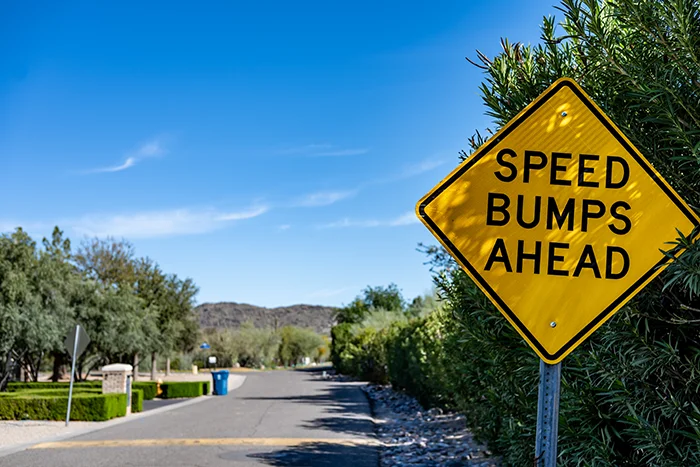
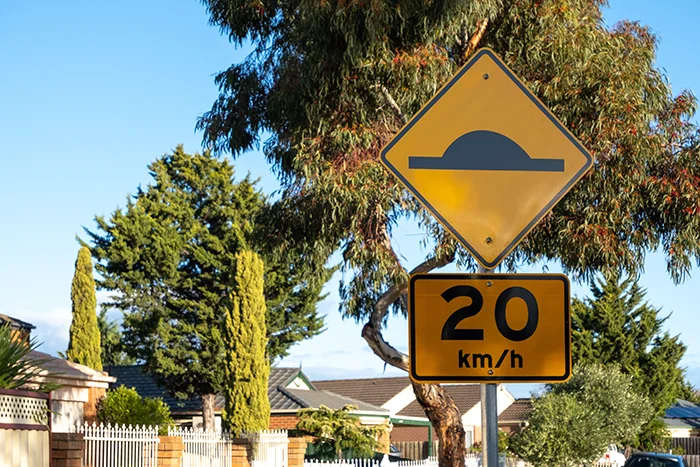
  • When traffic calming devices are used, appropriate warning signage must be installed (e.g., “BUMP” or “HUMP” signs with advisory speed plaques).
  • Devices must be painted or marked for visibility, typically with white or yellow reflective paint and chevrons.

Although CA MUTCD primarily governs public roadways, it serves as a best-practices standard that even private communities should follow to avoid liability and ensure safety.

Davis-Stirling Act Considerations for Speed Bumps in HOAs

The Davis-Stirling Common Interest Development Act, which governs most HOAs in California, doesn’t specifically address speed bumps. However, it requires boards to act in good faith, in the best interest of the community, and with reasonable care.

This means:

  • Boards must follow proper procedures, including board votes and notifications to potential homeowners.
  • Modifications to common areas (including roads) may require homeowner approval if stipulated in the HOA’s governing documents.
  • Boards must document decisions and demonstrate that they evaluated safety, costs, and legal compliance.

Public vs. Private Road Jurisdiction

The legality of installing speed bumps in HOAs hinges largely on road ownership:

  • Public Roads: These are owned and maintained by a city or county. HOAs cannot install speed bumps on these roads. Instead, they must petition the local agency, usually the Public Works Department or Traffic Engineering Division, to conduct a traffic study. Approval is rare, especially for speed bumps; however, other measures, such as speed humps or signage, may be considered.
  • Private Roads: If the HOA owns and maintains the roads, it typically has the authority to install traffic calming devices. Still, they should follow standards like those in the CA MUTCD and consult professionals to avoid negligence claims.

California Fire Code Compliance

car on a speed bump | speed bumps in HOAs

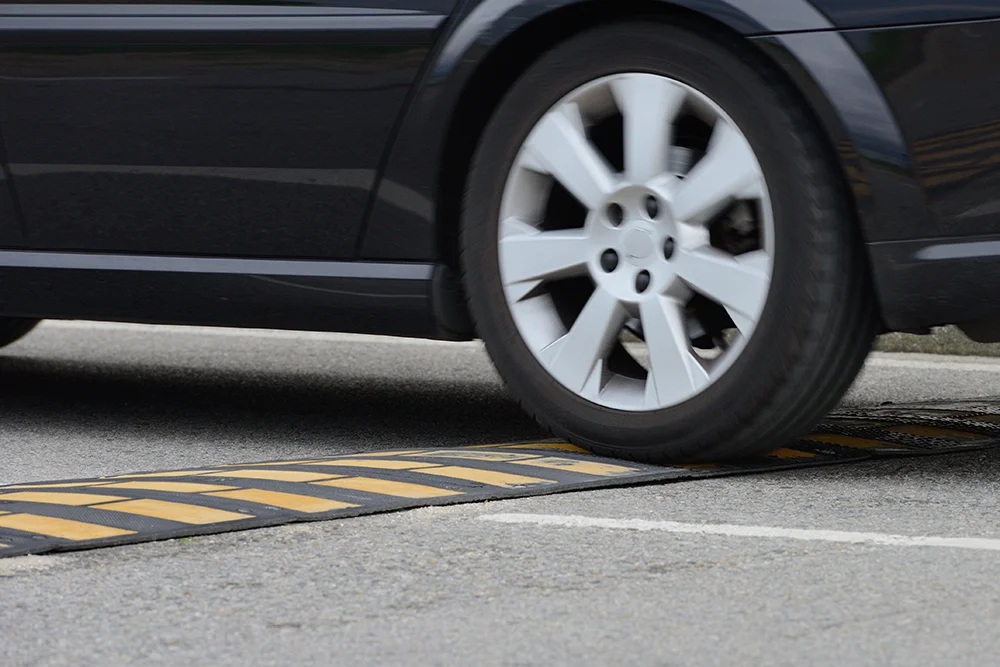
California’s Fire Code (and local interpretations of it) prohibit traffic-calming devices that impede emergency vehicle access. Fire departments often require a minimum vertical clearance and response-time adherence.

Speed bumps may delay the arrival of fire trucks, ambulances, or police vehicles. As a result, fire departments often oppose their use, especially taller or abrupt bumps. Some jurisdictions require HOAs to:

  • Get fire marshal approval before installing any device.
  • Use fire department-approved designs (e.g., speed cushions, which are divided to allow wide emergency vehicle axles to pass through).
  • Demonstrate that emergency response times will not be significantly impacted.

Liability and Case Law

California courts have not extensively litigated HOA speed bump liability, but general premises liability law applies. HOAs are considered responsible for maintaining safe common areas. Improper installation of a speed bump can lead to liability under California Civil Code § 1714, which deals with property owner negligence.

For instance, an improperly designed or unmarked bump that damages a car or causes a bicycle accident could expose the HOA to lawsuits.

Local Ordinances and Permits on Speed Bumps in HOAs

In addition to statewide standards, cities and counties in California often have their own public works codes and ordinances that regulate traffic calming. Common local requirements include:

  • A minimum number of homeowner signatures or petition support is required to initiate traffic studies.
  • Required speed or volume thresholds (e.g., average speed above 25 mph) to justify physical calming measures.
  • Noise or emergency access impact assessments.

Speed Bumps vs. Speed Humps: What’s the Difference?

While many people use these terms interchangeably, speed bumps and speed humps serve slightly different purposes and are designed differently.

FeatureSpeed BumpsSpeed Humps
Height3 to 6 inches3 to 4 inches
Width1 to 3 feet10 to 14 feet
Speed ReductionAbrupt, 2–10 mphGradual, 10–20 mph
ApplicationParking lots, alleysResidential streets
Emergency Vehicle ImpactHigh disruptionMinimal disruption

Speed humps are generally preferred for residential streets because they provide smoother transitions and don’t obstruct emergency response times as severely as traditional speed bumps.

Pros and Cons of Installing Speed Bumps in HOAs

Many HOA boards find real value in these traffic calming measures. However, they also come with numerous issues and challenges. Here are the benefits and drawbacks of installing speed bumps in your HOA community.

Pros

1. Enhanced Safety

The primary reason for installing speed bumps in HOAs is increased safety. By forcing drivers to slow down, these devices help protect children, pedestrians, and pets. Accidents are less likely to occur, and drivers become more aware of their surroundings.

2. Reduced Cut-Through Traffic

Speed bumps can deter non-residents from using HOA streets as shortcuts. When alternate routes are faster and more convenient, through-traffic tends to avoid the neighborhood.

3. Lower Noise and Pollution

Slower speeds often mean reduced engine noise and emissions. This is especially beneficial for densely populated communities where road noise can become a nuisance.

4. Liability Mitigation

When homeowners repeatedly complain about traffic dangers and the board fails to act, the HOA may be exposed to legal risk. Demonstrating proactive safety efforts, such as the installation of traffic calming devices, can show that the board is fulfilling its duty of care.

Cons

speed bump sign | speed bumps in HOAs

1. Legal and Financial Liability

Installing speed bumps without proper procedures, permits, or compliance can expose the HOA to legal claims. If a car is damaged or someone is injured due to poor design or lack of visibility, the HOA could be held responsible.

2. Emergency Access Concerns

Fire departments and EMS providers often object to speed bumps that obstruct response time. HOAs should always coordinate with emergency services to ensure compliance and accessibility.

3. Homeowner Pushback

Not every resident welcomes speed bumps. Complaints may include increased noise, vehicle damage, discomfort, or reduced property values. A divided community can lead to tension or even legal disputes.

4. Ongoing Maintenance Costs

Speed bumps need to be maintained. Paint fades, asphalt wears down, and damage occurs over time. Budgeting for routine upkeep is essential to avoid creating new hazards.

Alternatives to Consider for Speed Bumps in HOAs

If speed bumps prove controversial or unsuitable, HOAs can explore other traffic calming devices instead:

  • Speed Tables: These are longer and flatter than speed humps and can double as crosswalks.
  • Chicanes: Landscaping or curb extensions that create a winding road pattern to slow drivers.
  • Radar Speed Signs: Electronic signs that display current driver speed in real-time.
  • Mini Roundabouts: Promote continuous movement while slowing speed.
  • Lane Narrowing or Striping: Visually narrows roads to make drivers feel the need to slow down.

These alternatives can be effective and less intrusive depending on the community’s layout and traffic volume.

Best Practices for Installing Speed Bumps in HOAs

To successfully implement speed bumps or any other calming measure, HOA boards should follow a transparent and structured process:

1. Conduct a Traffic and Safety Study

Bring in a licensed traffic engineer to assess problem areas, measure speed and volume, and make recommendations. This protects the board from liability and provides a data-driven foundation.

2. Gather Community Feedback

Hold meetings, conduct surveys, and maintain open communication. The more informed and involved residents are, the less likely the board is to face resistance or backlash.

3. Consult Legal Counsel

Before final decisions, consult an attorney familiar with HOA law and local regulations. They can help interpret your governing documents and assess potential liability.

4. Coordinate with Emergency Services

Reach out to local police, fire departments, and EMS to ensure compliance and avoid hindering life-saving services.

5. Implement with Professionals

Never DIY a speed bump. Use licensed contractors, follow engineering specifications, and ensure proper signage and road markings are installed.

6. Review and Maintain

Monitor how effective the speed bumps are over time. Regularly repaint, repair, and review feedback to ensure ongoing safety and compliance.

Slowing Down, The Smart Way

Speed bumps in HOAs can be a valuable traffic control solution, but only when installed legally, safely, and with community buy-in. With careful planning and proper execution, your HOA can create a safer and more peaceful neighborhood that residents are proud to call home.

Need assistance in handling your day-to-day HOA operations? Personalized Property Management offers HOA and property management services around Southern California. Call us at 760-325-9500 or email us at info@ppminternet.com for more information!

Related Articles

What Is The VA Loan in California? How Can It Help Home Buyers?

Buying a home in California isn’t easy, more so for veterans trying to break into a market known for steep prices and tight competition. That’s why the VA loan program stands out, as it’s designed to give those who’ve served an edge when it comes to securing a home. But not every home qualifies, and the process can get tricky in HOA communities.

What is a VA Loan Exactly?

A VA loan is a mortgage backed by the U.S. Department of Veterans Affairs. It’s meant for veterans, service members in active duty, specific members of the National Guard and Reserves, and some surviving spouses. What makes it special is that you can buy a home without putting any money down—and without having to pay private mortgage insurance (PMI).

Instead of lending directly, the VA guarantees a portion of the loan. This backing gives lenders more confidence and often leads to better terms for you as the borrower. That’s a big deal in a state like California, where the cost of entry into the housing market is high.

Why Do VA Loans Matter So Much in California?

In most parts of the country, skipping the down payment is a helpful perk. In California? It’s a game-changer. Median home prices often hover well above $700,000, and in many areas, they’re even higher. For someone using a conventional loan, that means needing to save six figures just for a down payment.

With a VA loan, you can buy without putting anything down and still skip the monthly cost of PMI. Your savings from it add up fast, especially when you’re also budgeting for HOA dues, Mello-Roos taxes, or other community fees.

The VA loan also allows eligible buyers to borrow large amounts, sometimes exceeding $1 million, as long as they qualify based on their income and credit. No extra hoops. No jumbo loan down payments. Just the same no-money-down benefit, even on higher-priced homes.

What Sets the VA Loan Apart From Others?

Here’s why so many California veterans rely on it:

  • No down payment – Needing to have money for a down payment is often the biggest barrier to entry. Luckily, this loan removes it.
  • No PMI – Most low-down-payment loans require PMI, which can easily be a few hundred dollars a month. With a VA loan, you skip it entirely.
  • Competitive interest rates – Because of the VA backing, lenders often offer better-than-average rates.
  • Flexible credit requirements – When applying for this type of loan, you don’t need perfect credit to qualify.
  • Limited closing costs – The VA puts caps on what lenders can charge.
  • Reusable benefit – You’re not limited to just one VA loan in your lifetime. You can use it again if you meet the guidelines.

To put it simply, applying for a VA loan isn’t designed to be a backup option. Instead, it’s one of the best loan products out there.

How It Works in California

talking to an expert | what is va loan

The loan itself works the same no matter where you live, but California’s housing market adds a few wrinkles.

One of the biggest? High home prices. In counties like Los Angeles, Orange, and Santa Clara, standard homes often exceed conventional loan limits. But with a VA loan and full entitlement, that’s not a problem. You can borrow above those limits without needing a down payment, as long as the lender approves you for the full amount.

Then there are the state-level perks. In California, you can also find the following offers:

  • CalVet Home Loans – A separate program through the California Department of Veterans Affairs. You can’t use both loans on the same property, but it’s another solid option for eligible buyers.
  • Property tax exemptions – Disabled veterans may qualify for significant tax relief, depending on their income and disability rating.

And don’t forget to factor in HOA dues and local assessments. These are common in California and can affect your loan approval since they’re counted in your debt-to-income ratio.

Using a VA Loan in the Coachella Valley

The Coachella Valley is a popular landing spot for veterans, especially retirees. With sunshine, golf courses, and a slower pace of life, it’s easy to see the appeal. But the area is also full of HOA-managed communities, which bring their own set of rules.

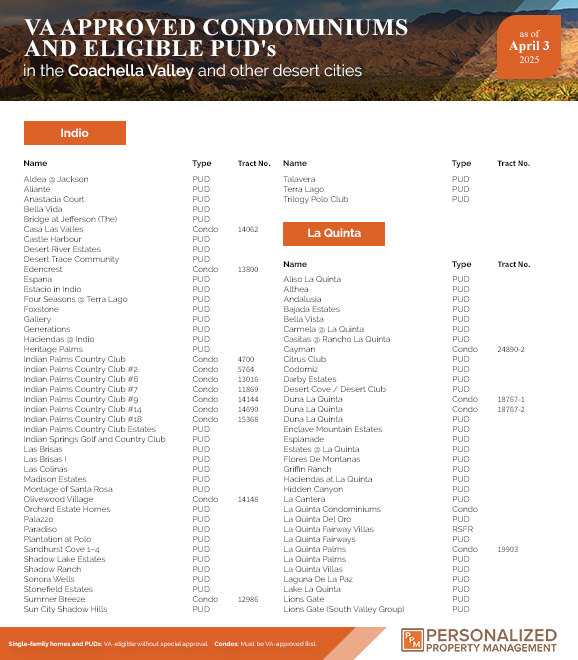
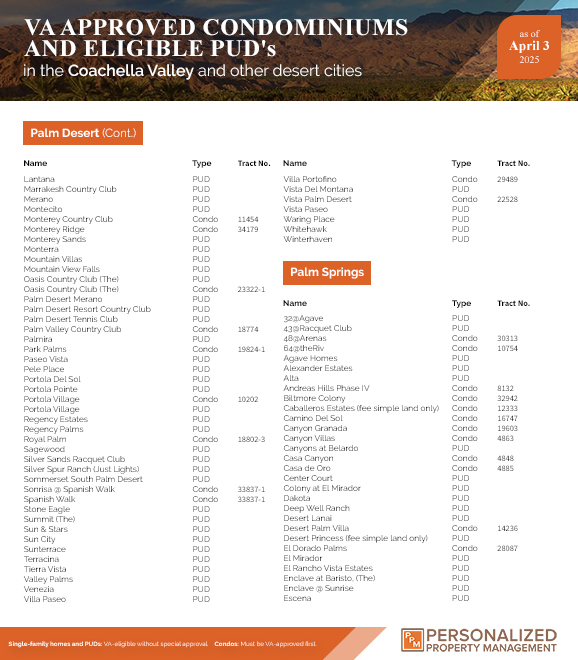
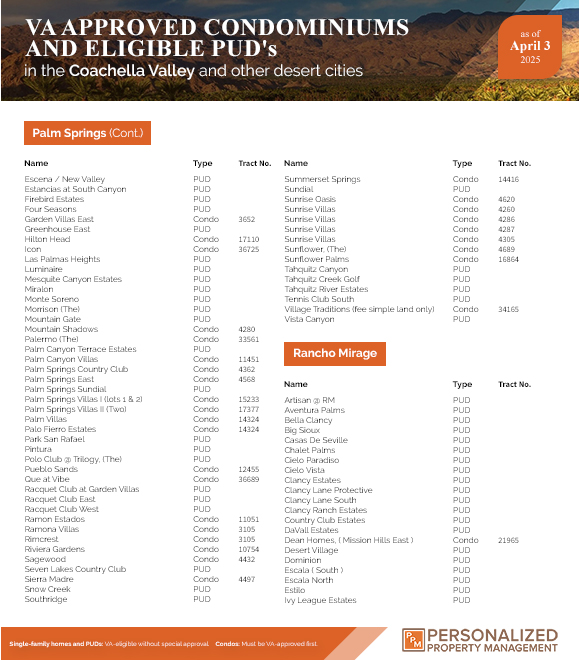
Most single-family homes and townhomes are eligible under VA guidelines, but many condos aren’t—unless the VA has officially approved the development. If you’re looking at a condo, you’ll want to check that list early. It can be the difference between a smooth loan and a dead end.

Also, properties on leased land are common in this region. Unfortunately, homes on leased land are usually not eligible for VA loans, which could limit your options in some neighborhoods.

That said, plenty of communities in the Coachella Valley are a good fit for VA financing. The key is knowing where to look—and working with people who know how the process works.

What is VA Loan vs. VA Mortgage?

They’re the same thing. Some lenders or websites might call it a VA mortgage, others a VA home loan. It all refers to the same government-backed loan program.

Whether you’re reading a loan estimate or a listing online, don’t overthink the wording—just make sure it’s a VA loan product and that the lender is VA-approved.

What Kinds of Homes Can You Buy?

Here’s where things get a little more specific. The VA has rules about what types of homes you can buy, and those rules are especially important in California, where condos, HOAs, and alternative property types are common.

Primary Residence Only

This isn’t for investment properties or vacation homes. You have to live in the home as your primary residence.

Single-Family Homes

The simplest option. These homes usually meet all VA requirements and don’t need extra approvals.

Condos

Here’s the catch: the entire condo development must be VA-approved. If it’s not, your lender can sometimes help apply for approval, but that takes time and isn’t guaranteed. Always check the VA’s condo list before falling in love with a unit.

Planned Unit Developments (PUDs)

These are communities with shared amenities and HOA oversight, like townhomes or gated neighborhoods. Most are VA-eligible, assuming the unit itself meets basic property guidelines.

Manufactured Homes

They’re allowed, but they have to be permanently attached to a foundation, meet HUD standards, and be considered real property. Not all lenders finance them, even if the VA allows it.

Multi-Unit Properties

VA loans can be used for duplexes, triplexes, or four-unit homes, as long as you live in one of the units full time.

Leased Land

This one’s tough. If the home sits on land you don’t own (common in resort communities or mobile home parks), it’s usually not eligible for a VA loan.

Bottom line: not every home is eligible for a VA loan. Before making an offer, ask your agent and lender to verify the property’s eligibility.

Applying for a VA Loan in California

You don’t need to be a loan expert, but it helps to understand the basics before you dive in. Here’s a breakdown of how to get started.

Step 1: Check Eligibility

Start by confirming you qualify. That usually means 90 days of wartime service, 181 days during peacetime, or six years in the Guard or Reserves. Surviving spouses may also qualify. Once you’re eligible, get your Certificate of Eligibility (COE) online or through your lender.

Step 2: Get Preapproved

The next step is preapproval. This is when the lender reviews your credit, income, and debts to figure out what you can afford. It’s also when you’ll learn how HOA dues or property taxes might impact your loan.

Step 3: Find the Right Property

You then need to look for the right property based on your needs and preferences. Work with an agent who knows the local VA landscape. They can help you avoid ineligible properties, especially important in areas with lots of HOAs or leased land.

Step 4: Appraisal and Underwriting

A VA-approved appraiser checks the value and condition of the home. Underwriters then review your full file to ensure everything meets guidelines.

Step 5: Close the Loan

Sign the paperwork, get the keys, and move in. You’ll need to occupy the home within 60 days (extensions available if you’re deployed).

A Quick Note 

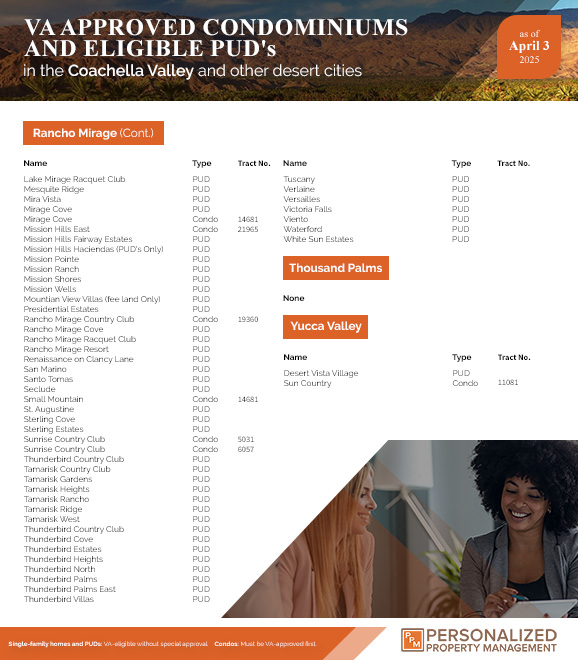
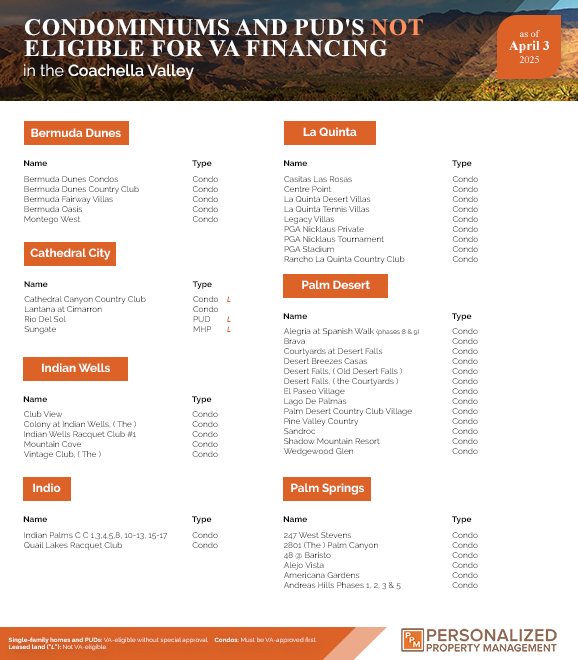
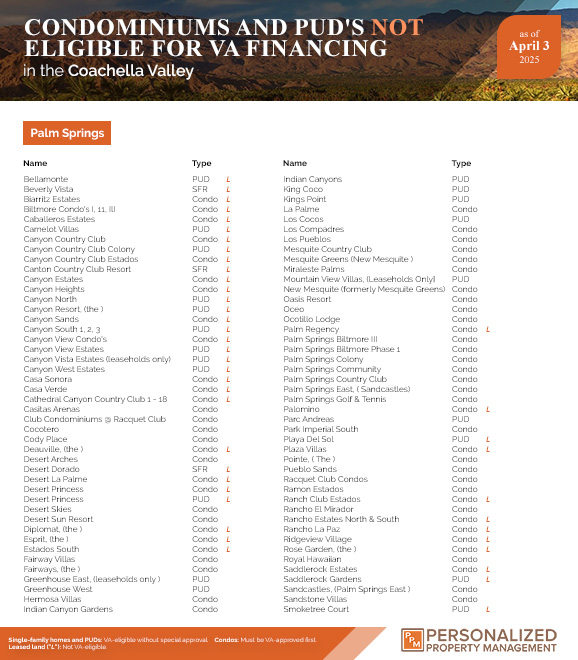
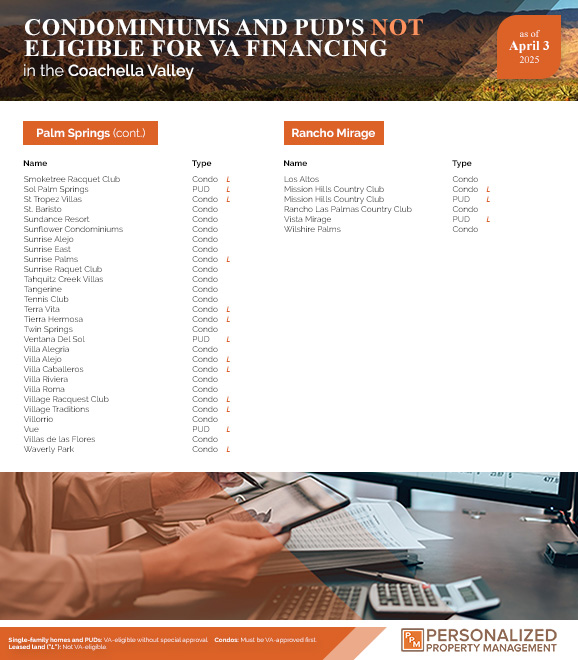
To make things easier for local buyers, Personalized Property Management put together a simple guide that outlines which properties in our managed communities are compatible with VA loans. It includes a clear legend and was last updated on April 3, 2025. If you’re looking at one of our communities and want help confirming eligibility, reach out.

VA Approved and Eligible Condominiums and PUDs in Coachella Valley

VA approved Condominiums and eligible PUDs in the Coachella Valley

Not VA Eligible Condominiums and PUDs in Coachella Valley

Not Eligible VA Condominiums and PUDs in the Coachella Valley

Navigating VA Loans in California

The VA loan can make a real difference, especially in a place like California, where every dollar counts. You’ve earned the benefit. Now it’s just a matter of using it wisely.

Do you need help in managing your property? Personalized Property Management offers HOA and property management services around Southern California. Call us at 760-325-9500 or email us at info@ppminternet.com for more information!

Related Articles: