
Clear parking access helps everyone find the front door. It also keeps your community out of trouble. This guide focuses on ADA parking compliance for HOAs and gives simple steps to keep private lots usable and safe.
ADA Parking Compliance for HOAs: What the Law Says
The Americans with Disabilities Act is a federal civil rights law that prohibits disability discrimination. Titles II and III require accessible routes, entries, services, and parking where the public is served. The 2010 ADA Standards for Accessible Design set the technical rules for layout and signs.
How does that affect an HOA? If a common area serves the public, such as a sales or leasing office, a clubhouse rented to outside groups, or a community office that admits visitors, the ADA applies to the way that space is designed and run. Even when an HOA does not open facilities to the public, using ADA rules as a design standard makes parking safer and more inclusive for residents and guests.
Two ideas drive most parking decisions. First, people must be able to get from their vehicles to the entrance along an accessible route. Second, the space itself has to fit real wheelchairs, lifts, and mobility devices.
In practice, that means the right number of accessible spaces, the right van stalls, the right signs, and a route that is shortest, smooth, and nearly level. Keep those four points in mind as your team reviews any plan.
How Many Accessible Spaces You Need?
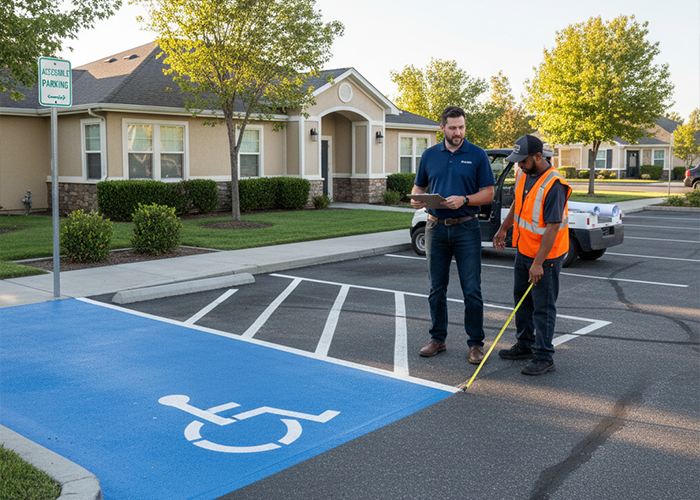
The count is based on the total number of stalls in each parking facility. Small lots need one accessible stall. As the lot grows, the number increases in steps.
A simple rule of thumb helps. One accessible stall is required for 1 to 25 total stalls, two for 26 to 50, three for 51 to 75, and four for 76 to 100. Larger lots follow a percentage schedule, and at least one of every six accessible stalls must be a van stall. When your count lands on a threshold, round up and check the van ratio?
Van-Accessible Dimensions and Clearances
Van users need room for side lifts and ramps. The ADA allows two basic layouts for van stalls. You can stripe a space that is 132 inches wide with a 60-inch access aisle, or a 96-inch space with a 96-inch access aisle. Either option works if all other details meet the standard.
Vertical clearance matters as much as width. Provide a clear height of at least 98 inches at the stall and along the vehicle route to and from it. Check under carports, gates, and garage entries. A lift is not helpful if the route pinches down along the way. Use the phrase van-accessible dimensions in your notes and bids so the contractor knows you expect the ADA layouts and clearances.
Location, Slope, and the Accessible Route
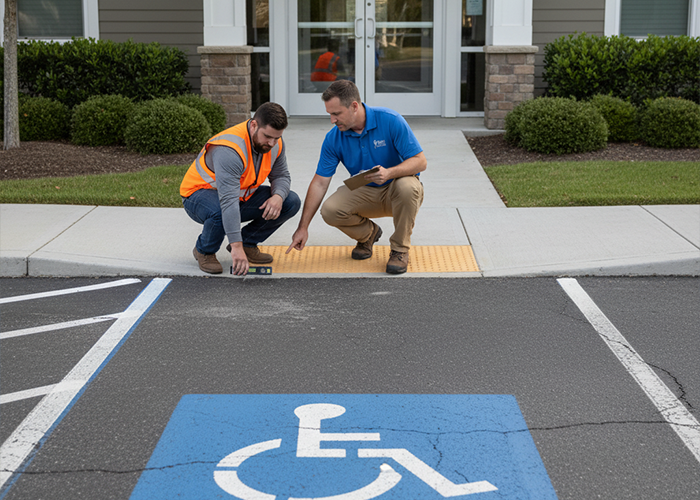
Place accessible stalls on the shortest accessible route to the accessible entrance. If several buildings share a lot, distribute spaces so each accessible entrance has an accessible stall nearby. People should not cross long distances or steep drive lanes just to reach the door.
Keep the surface nearly level. Both the stall and its access aisle should not exceed a gentle slope in any direction. The accessible route from the stall to the entrance should be firm, stable, and slip-resistant, without steps or abrupt changes in level. If a ramp is needed, use compliant slopes, landings, and handrails, and keep the path clear.
Signs for Accessible Parking
Signs make the rule visible. Each accessible stall needs a sign with the International Symbol of Accessibility. Van stalls add a second line that reads “Van Accessible.” Mount signs high enough so that a parked vehicle does not hide them. The ADA requires the bottom of the sign to sit at a minimum height above the ground surface so the message is readable from a distance.
Add one more operational aid. Tow policy signs at the lot entrance can support your enforcement program, which helps keep accessible stalls open for the people who need them. While tow rules come from other laws, a clear board at the entrance reduces conflict and confusion.
ADA Requirements for Striping and Marking

The ADA tells you how wide the space and the access aisle must be. It also defines where the aisle sits next to the stall and that the aisle and stall must be level and connected to an accessible route. The ADA does not prescribe paint color, crosshatch patterns, or curb colors. Many communities still use crosshatching and large “NO PARKING” letters in the access aisle as a management tool, and that practice can help, but it is not what makes a space compliant under the ADA.
Focus first on the measured widths, the route, the sign, and the van’s clear height. You can add striping details that fit your community’s look once the core rules are met.
Turning ADA Rules Into a Simple Layout Plan
Sometimes, ADA parking compliance for HOAs starts with a basic plan. Begin the process with a scaled sketch of the lot. Count the total stalls, then mark the required accessible stalls. Choose where van stalls should go and confirm the van route is free of low beams or pipes.
Next, draw each access aisle. Place aisles so users can deploy ramps without entering traffic lanes. Confirm that sidewalks, curb ramps, and door landings align with the access aisles. A good sketch answers most contractor questions before paint hits the ground.
Maintenance and Operations

Compliance is not one and done. Paint fades and signs bend. Build a quick inspection loop into your quarterly walk. Take photos, note dates, and log fixes. Small issues are easy to correct when caught early.
Resident reports help. Encourage people to flag worn markings or loose signs. Respond quickly, then update the log. Over time, those notes become a map for the next restriping project.
Proper Staff Training
Your manager and front desk team can prevent many issues with a simple script. When a resident asks about accessible parking, give clear directions to the nearest stall. When a delivery company blocks an access aisle, call the site supervisor right away and ask them to move. Keep the tone polite, and record the contact.
For events, ask hosts to keep accessible stalls and aisles clear. Provide cones if crowding is likely. People want to do the right thing, especially when the request comes early and the reason is clear.
Common Layout Mistakes to Avoid
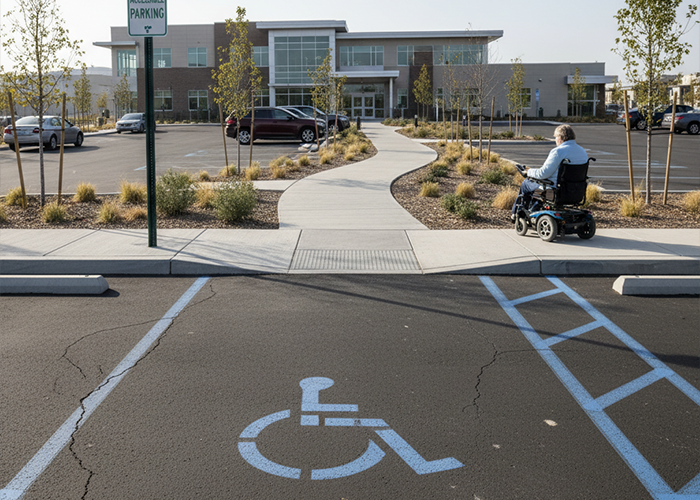
Aisles that are too narrow are common. So are aisles placed on the driver’s side when lifts deploy on the passenger side. Another frequent miss is a van stall that meets width rules but fails the 98-inch clear height along the route. Any of these can ruin an otherwise careful project.
The last common mistake is putting the accessible stall far from the entrance, then trying to fix it with extra signs. The ADA asks for the shortest accessible route. Put the stall where the route is shortest, then mark it well.
How to Phase Work Without Closing the Lot
You can upgrade in steps. Begin with the van stall. Confirm width, aisle, sign, and clear height. Then bring nearby car accessible stalls into compliance. Finally, improve the route with better curb ramps or smoother landings.
Tie work to planned maintenance where possible. If resealing or resurfacing is already on the calendar, schedule restriping and sign work at the same time. The combined project saves money and reduces downtime.
Readily Achievable Barrier Removal

For places that serve the public, the ADA asks businesses to remove barriers when removal is readily achievable. That means it can be done without much difficulty or expense. Re-striping a lot or adding a sign often fits that test. Rebuilding a garage level may not.
If a large fix is needed, plan and budget for it. Document what you considered, what you did, and what you plan to do next. Good records show progress and help defend the schedule.
ADA-Friendly EV Charging Near Accessible Stalls
EV charging can be placed near accessible parking if clearances are maintained. Keep the charger and bollards out of the access aisle. Confirm the cable reaches without crossing the aisle. If the cable must cross, place it so it lies flat and does not create a trip hazard.
As demand grows, consider adding an accessible route to a future EV stall. That way, the next upgrade is simple and the lot stays flexible.
Accessibility for All
Good parking design is a service, not just a rule. When you follow ADA basics, people reach your doors with less stress. Keep the plan simple, measure twice, and review it often to sustain ADA parking compliance for HOAs.
Looking for professional support in managing ADA compliance for your HOA? Personalized Property Management offers HOA management services around Southern California. Call us at 760-325-9500 or email us at info@ppminternet.com for more information!
Related Articles: